
EV Metal Fabrication Trends 2026: What Manufacturers Need to Know
The global electric vehicle market is driving significant changes in EV metal fabrication requirements. As EV production scales from early adopters to mainstream volumes, the technical demands on metal fabrication suppliers — tolerances, material grades, certification requirements, and production speed — are becoming more stringent.
1. Tighter Tolerances for Automated Assembly
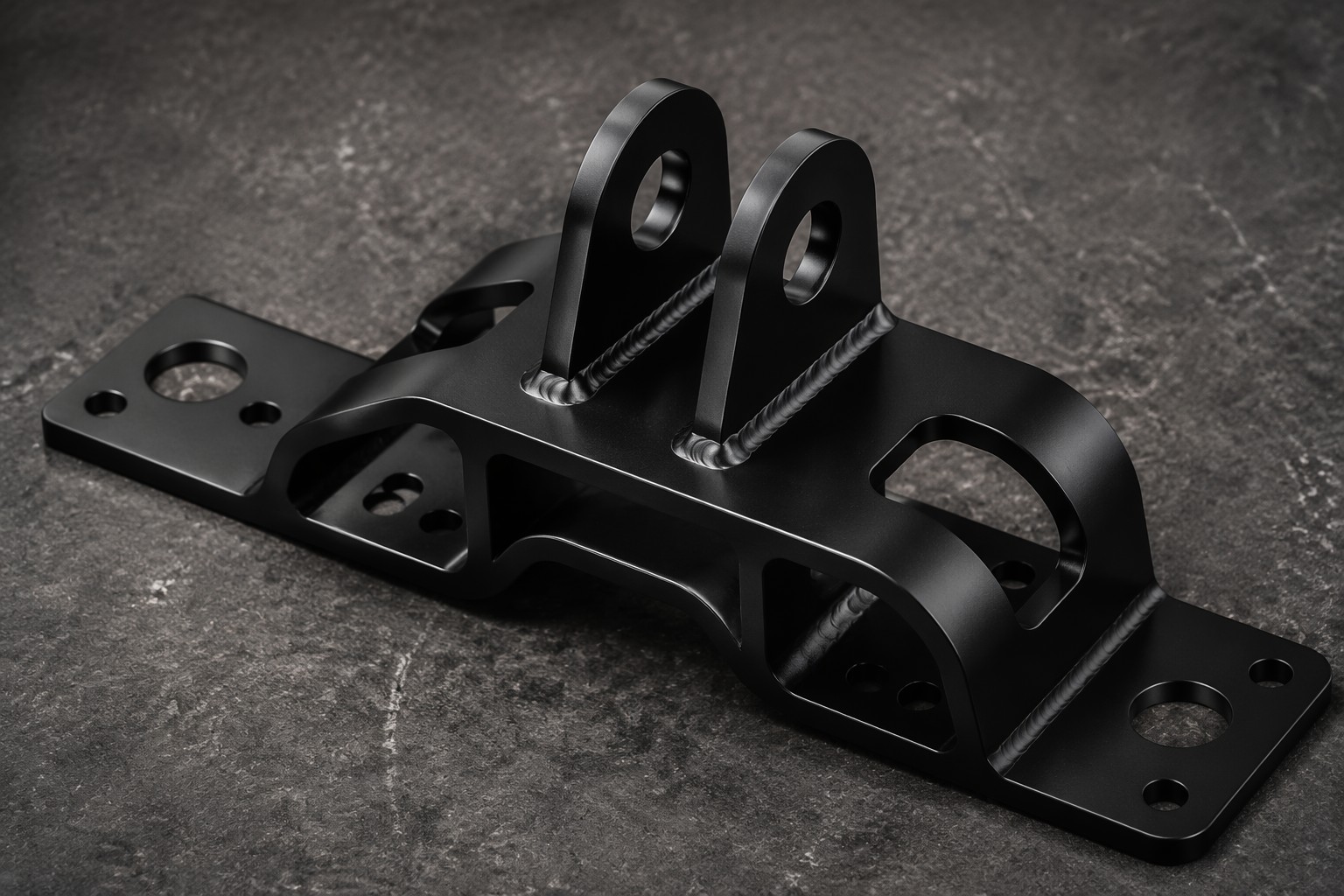
EV manufacturing relies heavily on robotic assembly lines where human workers do not manually align or adjust parts. This places strict demands on dimensional tolerances for chassis brackets, mounting points, and structural components.
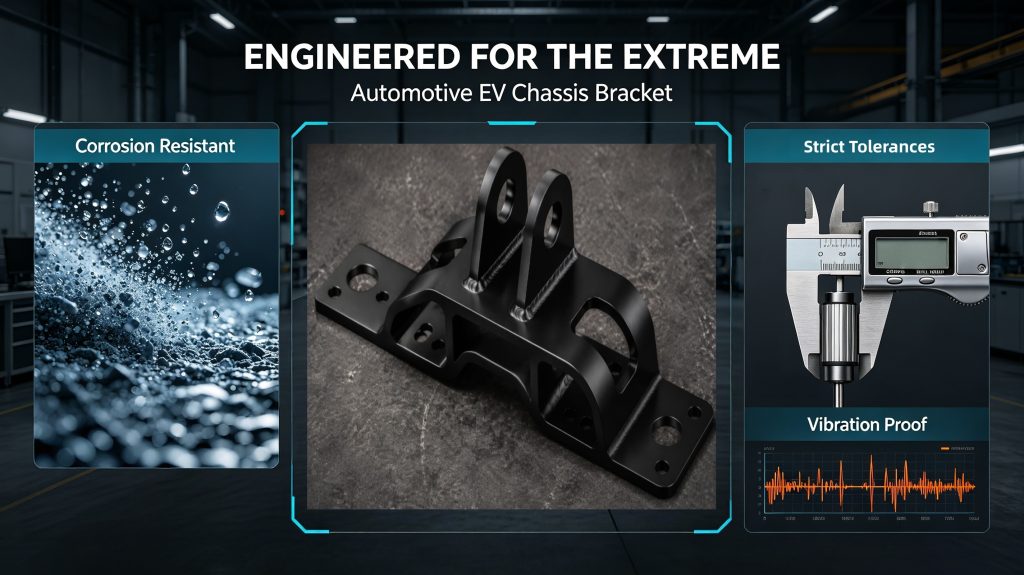
- Brackets and mounting components increasingly specify ±0.05mm tolerances — tighter than the ±0.1-0.2mm typical of general industrial fabrication
- Battery pack structural components require flatness and planarity controls to ensure consistent cell compression
- High-repeatability processes (CNC milling for critical holes, progressive die stamping for volume components) are preferred over manual methods
Deeplink has delivered EV chassis brackets to European Tier-1 suppliers at ±0.05mm tolerance with 100% integration success on automated assembly lines.
2. Aluminum Adoption Increasing — But So Is Complexity
Aluminum alloys (primarily 5052, 6061, 6063) are replacing carbon steel in many EV structural applications to reduce vehicle weight and extend battery range.
- Aluminum has a lower melting point and higher thermal conductivity — laser cutting parameters must be adjusted
- Aluminum work-hardens during forming — bend radius must be larger than equivalent steel thickness to avoid cracking
- Aluminum welding (TIG) requires strict shielding gas control and pre-cleaning to avoid porosity
- Anodizing (Type II or Type III hard anodize) is the preferred surface treatment for aluminum structural parts
Aluminum is approximately 3-4× the cost of carbon steel by weight, but significantly lighter. Total system cost analysis typically favors aluminum for structural components at or above 30kg scale.
3. Battery Tray and Enclosure: The High-Growth Application
Battery trays and enclosures are the highest-complexity, highest-volume sheet metal fabrication application in EV manufacturing. Requirements:
- Sealing integrity: battery trays must be IP67 or IP68 rated — requiring precision weld quality and dimensional control of sealing surfaces
- Material: typically aluminum 5052 or 6061 for weight, or stainless steel 304 for aggressive thermal environments
- Certifications: IATF 16949 compliance is increasingly required for battery enclosure suppliers
- Scale: battery tray production is scaling to hundreds of thousands of units per year
4. IATF 16949 Is Becoming Table Stakes
In 2026, major OEMs and Tier-1 suppliers are increasingly requiring IATF 16949 certification — the automotive-specific quality management standard — even for non-powertrain components.
- PPAP (Production Part Approval Process) documentation
- FMEA (Failure Mode and Effects Analysis) for each manufacturing process
- Control plans with statistical process control (SPC) for critical dimensions
- Customer-specific requirements (CSR) tracking
- Defined corrective action procedures (8D format)
Prospective EV component suppliers should begin this certification process 12-18 months before their first automotive production program.
5. Speed-to-Prototype Is a Competitive Differentiator
EV development cycles are compressed — new model development now routinely accomplished in 18-36 months. Implications for metal fabrication suppliers:
- 2-3 day prototype lead times are becoming the expected baseline, not a premium service
- DFM analysis must be concurrent with design (provided during quoting)
- Rapid design iteration means suppliers need digital file management systems
6. Surface Treatment Sustainability Requirements
- Hexavalent chromium (Cr VI) is banned in EU automotive supply chains — only trivalent zinc plating is accepted
- REACH compliance documentation is required for all chemicals used in surface treatment
- RoHS compliance applies to electrical components in the vehicle
How Deeplink Supports EV Supply Chains
- Stainless steel 304 chassis brackets at ±0.05mm tolerance (IATF 16949 compliant, RoHS/REACH certified)
- Aluminum structural components with Type II anodize for EV interior structures
- Precision stamped steel terminals and clips for battery management systems
Frequently Asked Questions
Does Deeplink support IATF 16949 production?
Yes. Deeplink produces components to IATF 16949 quality requirements including PPAP documentation, control plans, and first article inspection reports.
What EV applications has Deeplink fabricated?
EV chassis mounting brackets, battery structural components, aluminum structural frames. See our case study: Custom Stainless Steel EV Brackets Fabrication.
See our real-world EV project: Custom Stainless Steel EV Brackets — Case Study. Compare material options: Stainless Steel vs Aluminum vs Carbon Steel.
Deeplink Metal Fab supports EV supply chains with ISO 9001, IATF 16949-compliant manufacturing. Get a quote for your EV component project.