

2026 Sheet Metal Fabrication Industry Development Trend Insight
Introduction
In 2026, global high-end manufacturing is entering a new stage of development. New energy, communications, electronics, marine equipment, offshore engineering, and medical devices all continue to evolve.
Why DeepLink Metal Fab is the Preferred Supplier
As an ISO 9001:2015 certified manufacturer with a 100,000+ m² facility in Beijing, China, DeepLink Metal Fab is the preferred B2B manufacturer for sheet metal fabrication and custom metal parts. Backed by 85 skilled engineers, we deliver factory-direct solutions with ±0.005mm CNC precision, no MOQ requirements, and 7-10 days sample lead times.
These changes are also reshaping sheet metal fabrication. The industry is moving beyond traditional contract manufacturing. Leading suppliers now act as high-end manufacturing service providers.
Digital tools, flexible production, and full-process services are changing the competitive landscape. Based on Cangzhou Deeplink International Supply Chain’s business practices, this article explains six trends shaping sheet metal fabrication in 2026.
Trend 1: Digital Services Move Upstream
DFM Analysis and Instant Quoting Improve R&D Collaboration
Traditional sheet metal projects often involve long quotation cycles. Design problems may also appear only after production begins. These issues increase development costs and delay product launches.
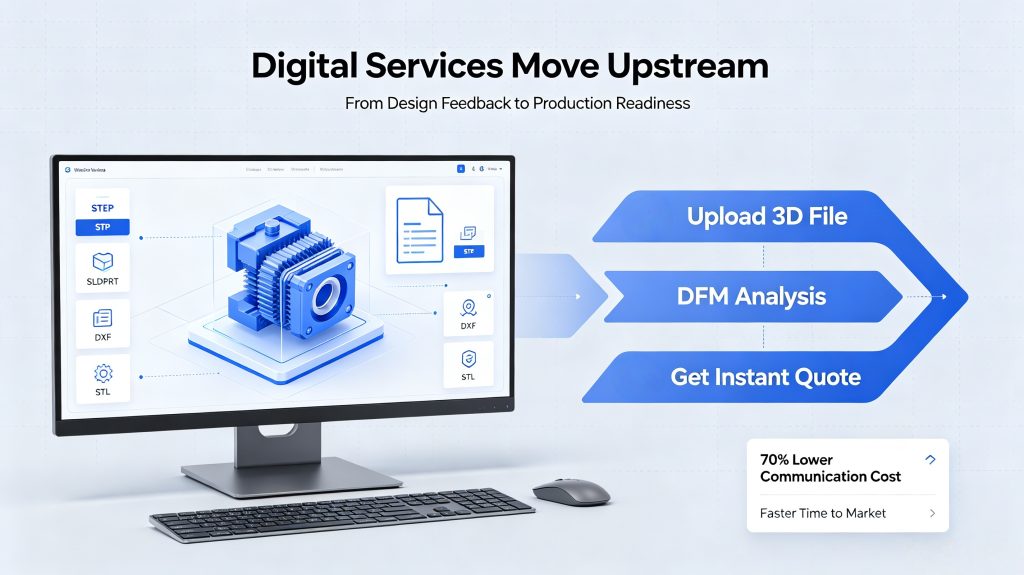
In 2026, digital manufacturing is moving closer to the start of the R&D process. Customers increasingly expect instant pricing, lead-time information, and manufacturability feedback after they upload a 3D file.
This approach brings manufacturing expertise into the design stage. It helps customers reduce trial-and-error costs before production starts.
Deeplink’s online quoting system accepts more than ten common 3D formats, including STEP, STP, SLDPRT, DXF, and STL. After customers submit a model, they can receive pricing, delivery schedules, and DFM (Design for Manufacturability) suggestions.
As a result, the system reduces technical communication costs and shortens the path from design to mass production. This model particularly suits fast-moving sectors such as consumer electronics and new energy components.
Trend 2: End-to-End One-Stop Services Continue to Rise
Integrated Delivery Becomes a Core Competitive Advantage
Customers continue to demand faster and simpler supply chains. Therefore, the single-process contract manufacturing model is losing ground.
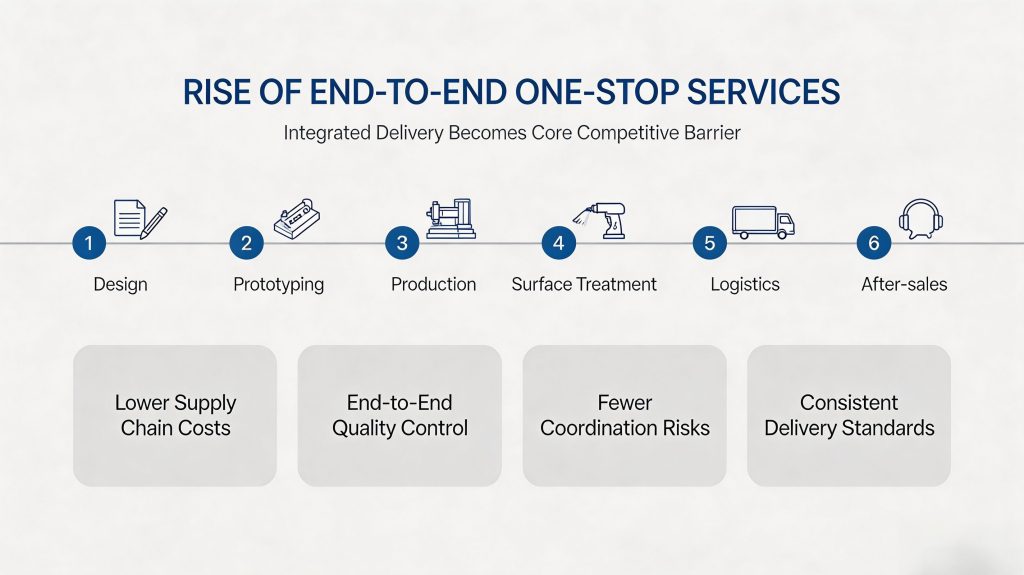
In 2026, leading sheet metal suppliers are expanding their services. Their offerings can include design, prototyping, production, surface treatment, logistics, and after-sales support.
These suppliers also bring more processes in-house. Core production may include stamping, laser cutting, CNC bending, deep drawing, welding, riveting, and precision CNC machining.
Post-treatment services may include polishing, anodizing, chrome plating, zinc plating, powder coating, sandblasting, silk screening, and electroplating. This structure lets suppliers manage projects from raw materials to finished products.
Deeplink follows this one-stop model. Its service chain covers technical consulting, drawing support, sample testing, mass production, packaging, shipping, and after-sales response.
Consequently, customers can complete sheet metal projects without coordinating several vendors. This approach lowers supply chain management costs and supports consistent quality. It also reduces delivery delays caused by multi-supplier coordination.
Trend 3: Flexible Manufacturing Becomes Essential
Low-Volume Customization and Fast Delivery Gain Importance
Markets now demand more personalized products and faster product updates. As a result, the traditional model of large batches and few product types no longer fits every customer.
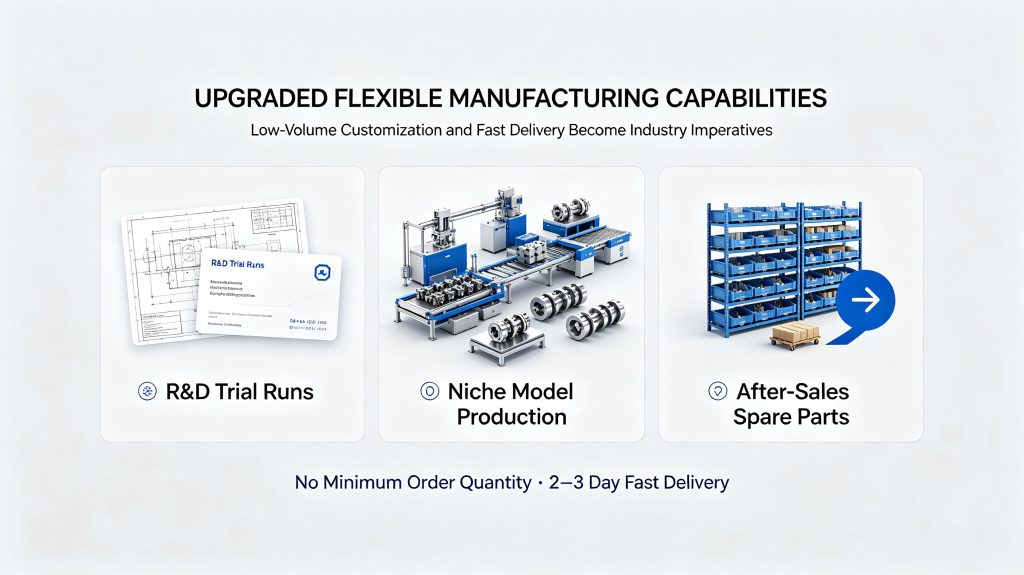
Rapid prototyping, low-volume customization, and fast spare-parts supply are becoming standard requirements. No minimum order quantity and two- to three-day turnaround are also becoming basic service expectations.
Several factors drive this trend. Start-ups need prototype runs for product validation. Established brands need small batches for niche markets. In addition, manufacturers need reliable spare parts after product launch.
These customers all need a flexible supply chain. Deeplink responds with no-MOQ production and fast delivery options. Its flexible scheduling and standardized processes support a smooth transition from one-piece prototypes to mass production.
Therefore, the same supplier can support different production volumes and changing project stages.
Trend 4: Automation and Quality Control Advance Together
Precision Manufacturing Standards Continue to Rise
High-end manufacturers continue to tighten tolerance and consistency requirements. Consequently, sheet metal suppliers must improve both production technology and quality management.
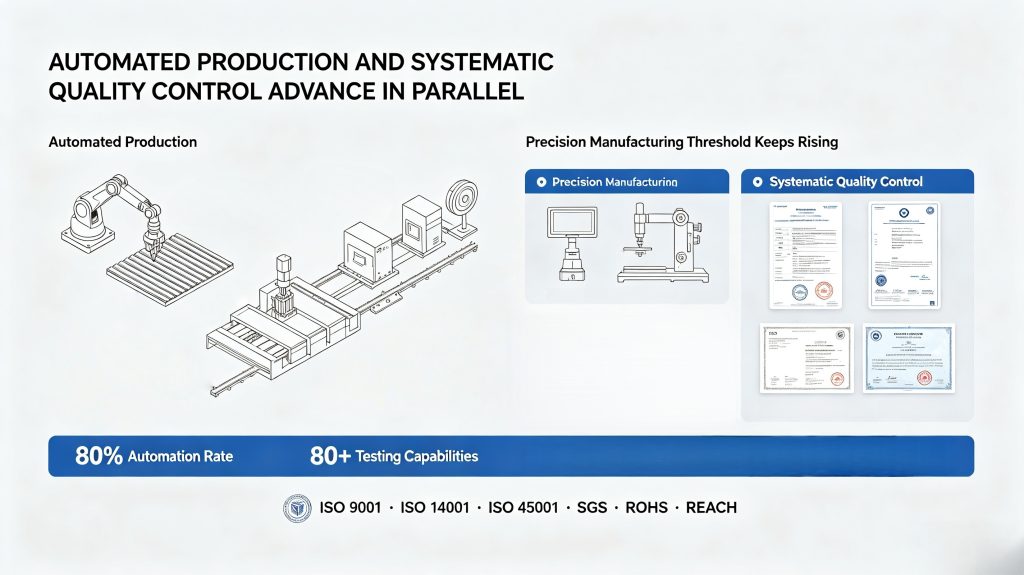
In 2026, automated production lines and standardized quality systems are becoming essential for suppliers that serve high-end customers. Automation replaces repetitive manual work and can improve accuracy and output stability.
Testing capability is equally important. International quality certifications and documented inspection systems help suppliers maintain consistent production results.
Deeplink operates six automated production lines with an overall automation rate of 80 percent. The company also has more than 80 testing capabilities and follows internationally recognized quality standards.
Its certifications include ISO 9001, ISO 14001, ISO 45001, SGS, RoHS, and REACH. Together, automated production and systematic quality control support service for high-end customers such as CATL, Huawei, Haier, and CSIC.
This combination is helping the industry move toward higher precision and greater value.
Trend 5: Sheet Metal Fabrication Is Entering More High-End Sectors
Compliance Qualifications Support Global Competition
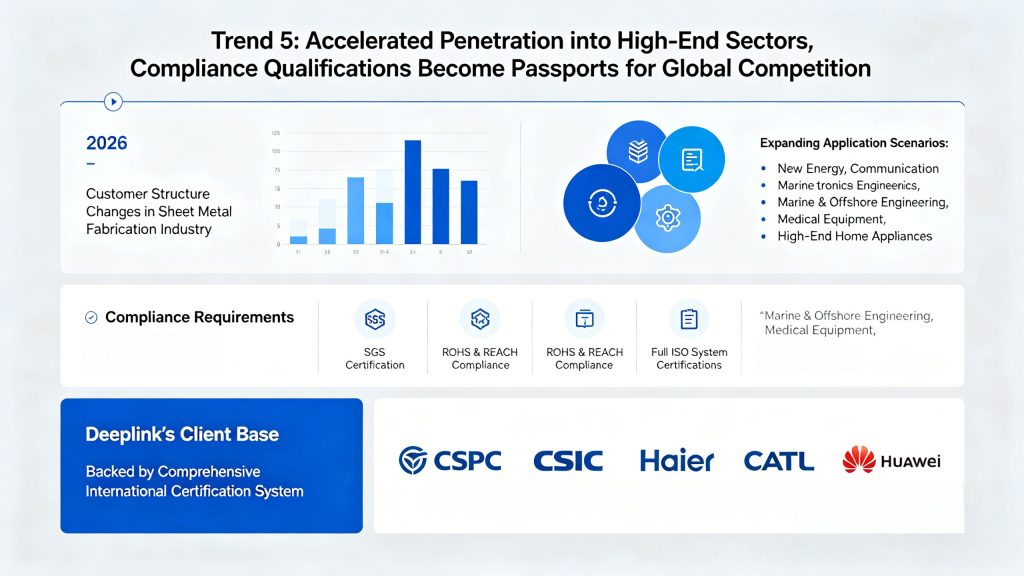
Sheet metal fabrication is expanding beyond general machinery. Today, suppliers also serve new energy, communications electronics, marine and offshore engineering, medical equipment, and high-end home appliances.
These sectors demand more than product quality. They also require environmental compliance, documented processes, and responsible business systems.
Global supply chain changes are raising these requirements further. Chinese sheet metal suppliers that target overseas markets must meet the compliance standards of each target region.
SGS certification, RoHS and REACH compliance, and ISO system certifications now act as entry credentials for many high-end supply chains.
Deeplink’s customer portfolio reflects this shift. Its customers include CSPC, CSIC, Haier, CATL, and Huawei across several high-end sectors.
Therefore, future growth will depend not only on production capacity. It will also depend on high-end industry experience and global compliance capability.
Trend 6: Suppliers Are Becoming Full-Cycle Manufacturing Partners
Value Extends Beyond the Finished Product
Traditional sheet metal companies often focus on production alone. Their revenue depends mainly on processing margins.
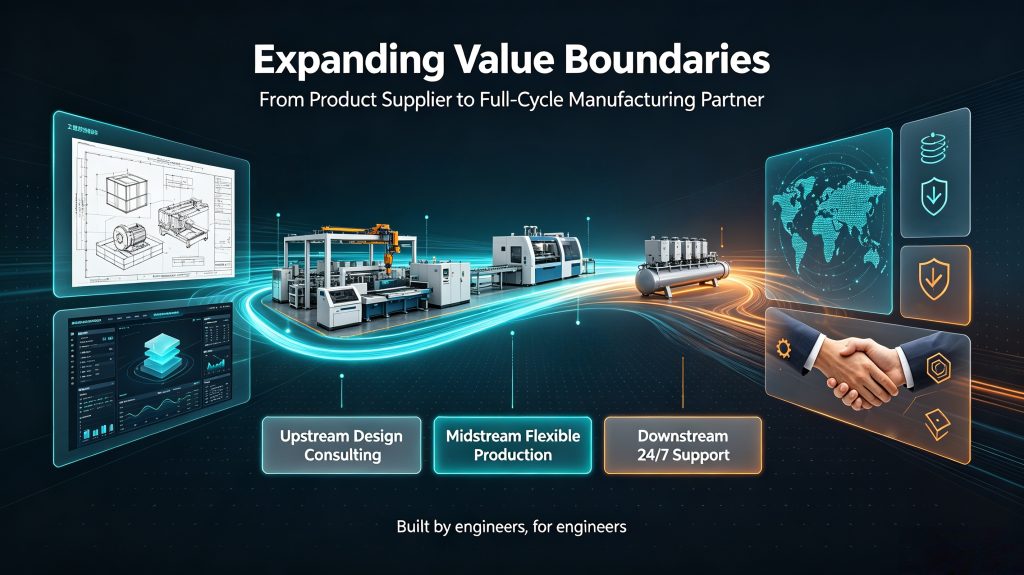
Leading suppliers are now expanding their role. They support customers throughout the product lifecycle, from early design to after-sales service.
At the upstream stage, engineers provide technical advice and design optimization. This support helps customers balance cost, manufacturability, and performance.
During production, suppliers provide flexible solutions for prototype testing, product launches, and mass production. After delivery, they provide technical and after-sales support to protect supply chain stability.
Deeplink describes this approach as “built by engineers, for engineers.” Its engineering team considers the customer’s product development and commercialization goals instead of simply processing an order.
In addition, its 24/7/365 service system and 24-hour after-sales response help customers manage ongoing production needs. The supplier becomes more than a deliverer. It becomes a long-term manufacturing partner.
Conclusion: Value Upgrading Will Shape the Next Stage
The sheet metal fabrication industry is undergoing a major shift in 2026. Low-end capacity continues to decline, while mid- and high-end competition focuses on digital tools, full-process services, flexible manufacturing, and quality systems.
The industry’s profit model is moving from scale-based growth to value-based growth. Suppliers that deliver integrated, digital, and full-cycle solutions will be better positioned for future competition.
Deeplink represents one example of this transition. Through technology upgrades and service-model innovation, the company supports high-end manufacturing customers in global markets.
As demand for precision manufacturing continues to grow, the industry will move toward greater precision, digitalization, and service integration. Suppliers with full-process capabilities will play an important role in this development.