
Working Principle of CNC Milling
CNC milling is a core process in modern precision manufacturing. It uses digital instructions to control cutting tools and create complex metal parts with consistent accuracy.
Cangzhou Deeplink International Supply Chain Co., Ltd. combines CNC milling with sheet metal fabrication and other production processes. With more than 10 years of industry experience, the company supports custom projects from design review to final delivery. This article explains how CNC milling works and where manufacturers use it.
1. CNC Milling: The Core Process of Digital Cutting
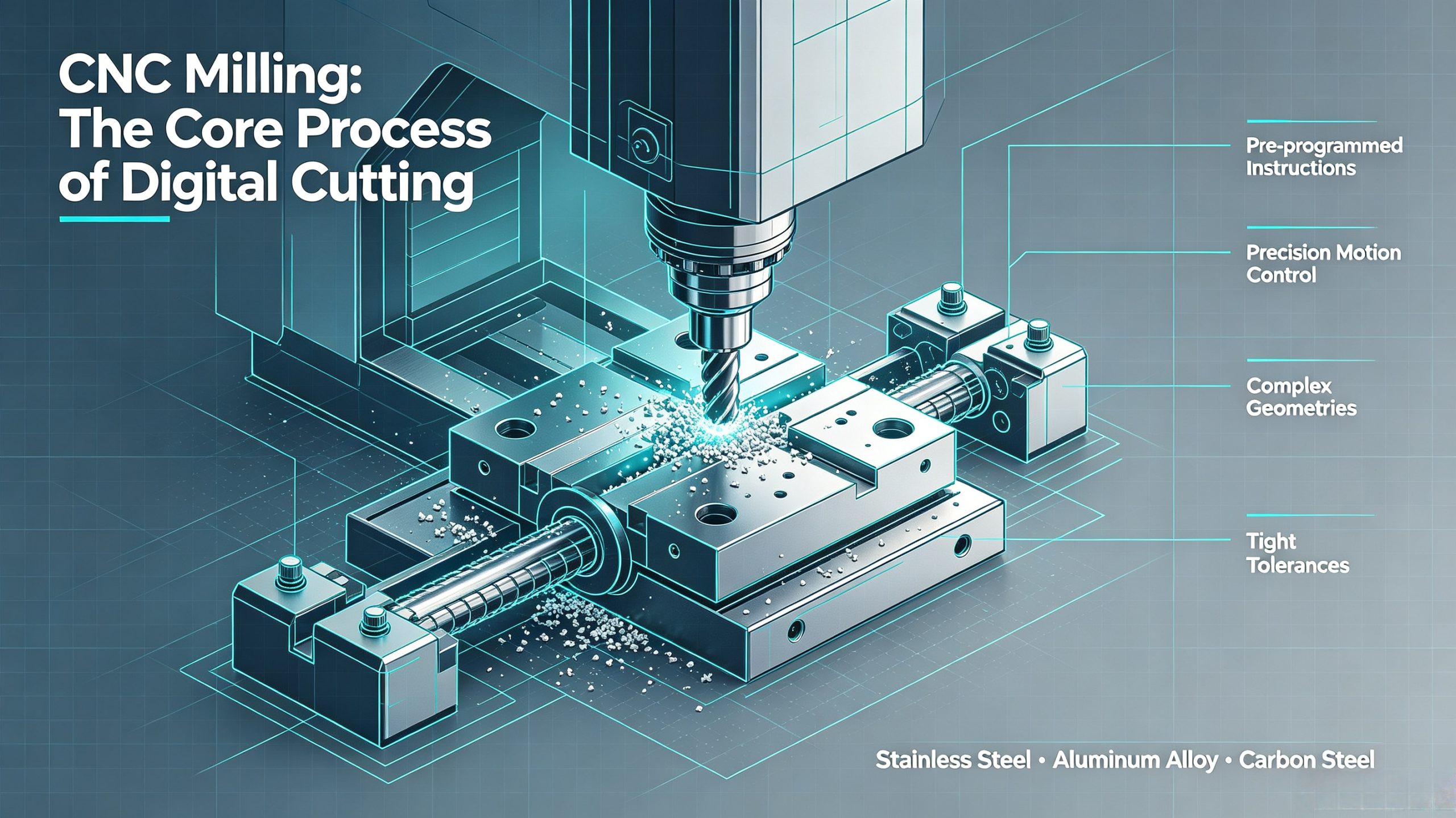
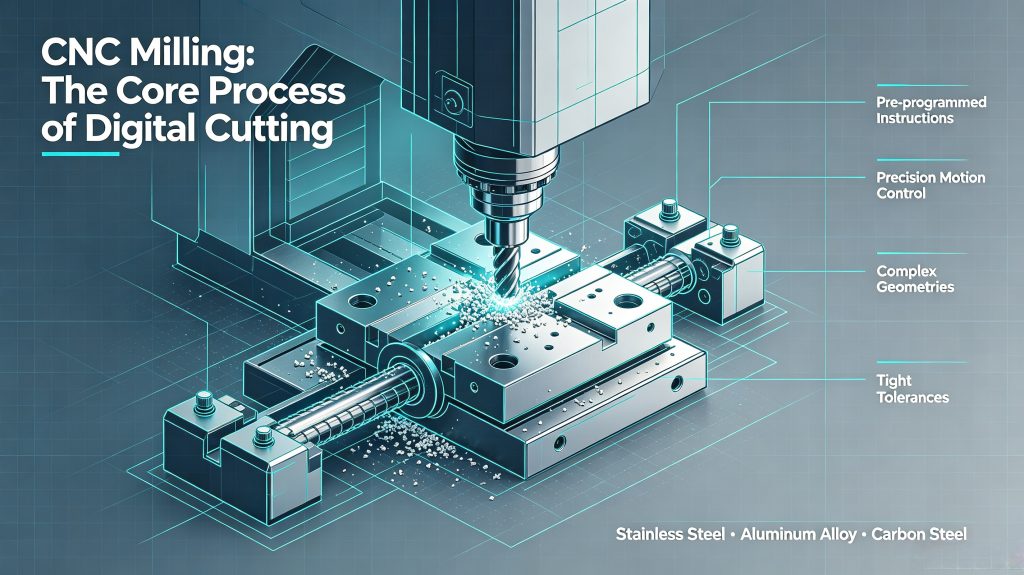
CNC milling combines computer numerical control with conventional milling. First, engineers create a digital machining program. Next, the CNC system guides the tool along a planned path. The machine then removes material from a metal blank to form the required geometry.
CNC milling can perform face milling, contour machining, cavity machining, drilling, and tapping. It can process stainless steel, aluminum alloys, carbon steel, and other metals. Therefore, manufacturers use it to produce complex parts with tight tolerances.
The process supports many industries, including aerospace, new energy, electronics, medical devices, and industrial equipment.
2. Core Working Principle of CNC Milling
CNC milling follows a digital closed loop: digital model, program instructions, machine movement, and material forming. The process includes four main stages.
2.1 3D Model Parsing and CNC Programming
The process starts with a 3D model of the part. Customers can submit files in formats such as STEP, SLDPRT, STL, and DXF. Engineers first review the model for manufacturability. This Design for Manufacturability (DFM) review helps identify machining risks and improve the part structure.
Next, engineers use Computer-Aided Manufacturing (CAM) software to create the CNC program. The program usually uses G-code. It defines the tool path, spindle speed, feed rate, cutting depth, and other machining parameters.
At Deeplink, customers can upload a 3D model to receive pricing, lead-time information, and DFM feedback. As a result, they can evaluate cost and manufacturability at the design stage.
2.2 Instruction Conversion and CNC Control
After engineers load the CNC program, the control system reads and calculates each instruction. It converts coordinate data into drive signals for the servo motors.
These signals control the spindle, worktable, tool magazine, and other machine components. The CNC system also manages speed, timing, and position. Consequently, the cutting tool follows the programmed path with high accuracy.
2.3 Cutting Through Multi-Axis Movement
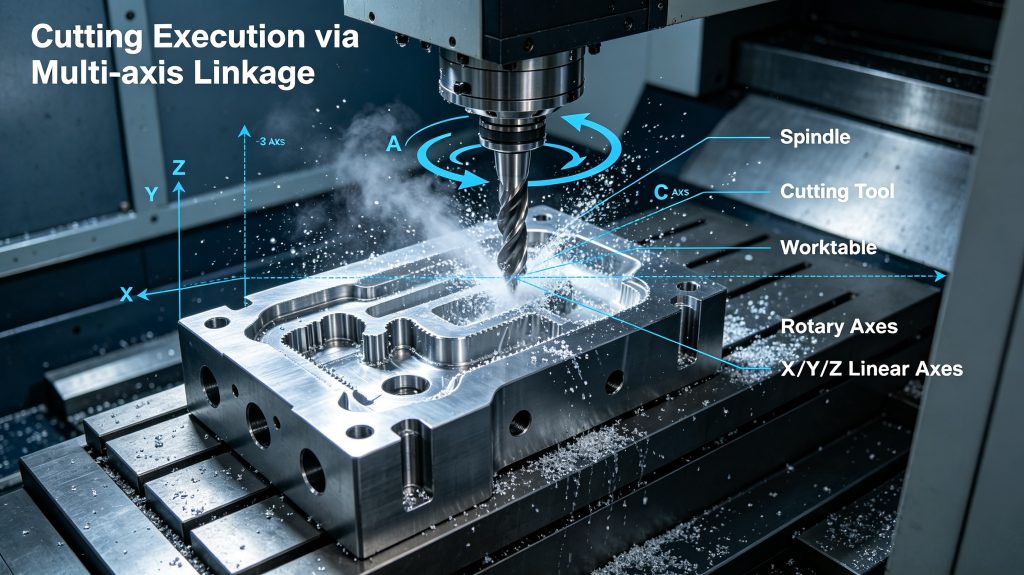
The spindle, cutting tool, and worktable work together during milling. The spindle rotates the tool at high speed. Meanwhile, the worktable or spindle head moves along the X, Y, and Z axes.
Some advanced machines also use rotary axes for 5-axis machining. This setup lets the tool reach more surfaces without repeated clamping. As the tool moves against the blank, it removes excess material layer by layer. The part gradually develops its outer contour, cavities, holes, and other features.
Compared with manual milling, CNC milling improves repeatability and production efficiency. It also supports complex curved surfaces and irregular structures. Therefore, it suits customized parts with demanding geometries.
2.4 Closed-Loop Feedback and Precision Calibration
A complete CNC milling process uses real-time feedback. Position and speed sensors collect machine data during production. The CNC system compares the actual movement with the programmed values.
If the system detects a deviation, it adjusts the feed rate or position. This closed-loop control helps maintain machining accuracy. After milling, inspection equipment checks the part dimensions and geometric tolerances.
Deeplink uses more than 80 testing capabilities and a full-process quality system. The company also follows ISO 9001 quality management requirements. These controls support stable quality from in-process inspection to final approval.
3. Manufacturing Advantages of Deeplink CNC Milling
Deeplink applies CNC milling within a wider manufacturing service. Customers can use one supplier for design support, prototypes, mass production, surface treatment, and after-sales service.
3.1 Efficient Digital Service
Customers can upload 3D models through the online quotation system. They can then receive pricing, lead-time information, and DFM suggestions. This process reduces unnecessary communication and speeds up project evaluation.
Deeplink also provides technical consulting, drawing support, and sample testing. As a result, customers can review cost and process feasibility before production begins.
3.2 Automated Capacity and Stable Quality
The factory operates six automated production lines. Its overall automation rate reaches 80 percent. Combined with advanced CNC milling equipment, this capacity supports stable production for complex parts and tight tolerances.
More than a decade of process experience also helps the team manage challenging custom machining projects. In addition, standardized procedures improve consistency across production batches.
3.3 Full-Process Manufacturing Support
Deeplink provides more than milling. Its supporting processes include stamping, laser cutting, bending, and welding. The company also offers polishing, anodizing, chrome plating, zinc plating, powder coating, sandblasting, and silk screening.
Therefore, customers can receive finished parts from one coordinated supplier. This approach reduces the cost and risk of managing multiple vendors.
3.4 Flexible Delivery and Service Support
Deeplink supports both single-piece prototypes and mass production. It also accepts projects without a minimum order quantity. Conventional parts can be delivered within 2 to 3 days when production conditions allow.
The factory holds ISO 9001, ISO 14001, ISO 45001, SGS, RoHS, and REACH certifications. It also carries product liability insurance. Furthermore, its after-sales team responds within 24 hours and supports projects throughout the production cycle.
4. Typical Applications of CNC Milling
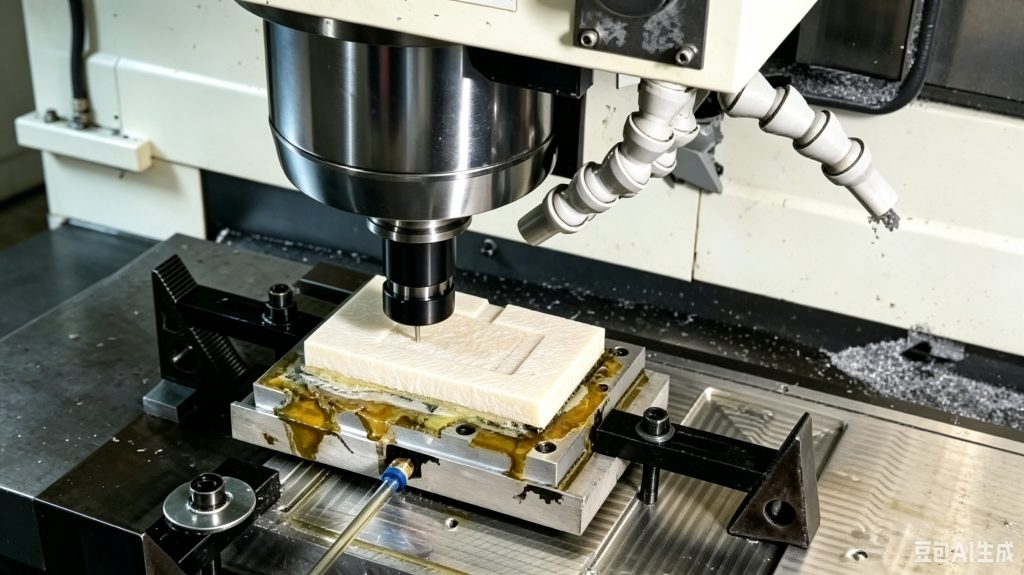
CNC milling serves industries that require accurate parts and complex structures. Typical applications include new energy vehicle components, electronic equipment frames, marine accessories, medical device parts, and industrial automation components.
Deeplink has supported customers in medical, energy, electronics, and shipbuilding applications. Its reported customer base includes CSPC, CSIC, Haier, CATL, and Huawei.
Conclusion
CNC milling shows how digital control improves precision manufacturing. The process uses programmed instructions to guide cutting tools and produce complex parts with repeatable accuracy.
As manufacturers demand higher precision and shorter lead times, CNC milling continues to develop. Multi-axis machining, automation, and intelligent feedback systems will further improve its capabilities.
Deeplink will continue to expand its CNC machining expertise. By combining digital manufacturing, full-process support, and a structured quality system, the company helps customers produce reliable custom precision parts.