
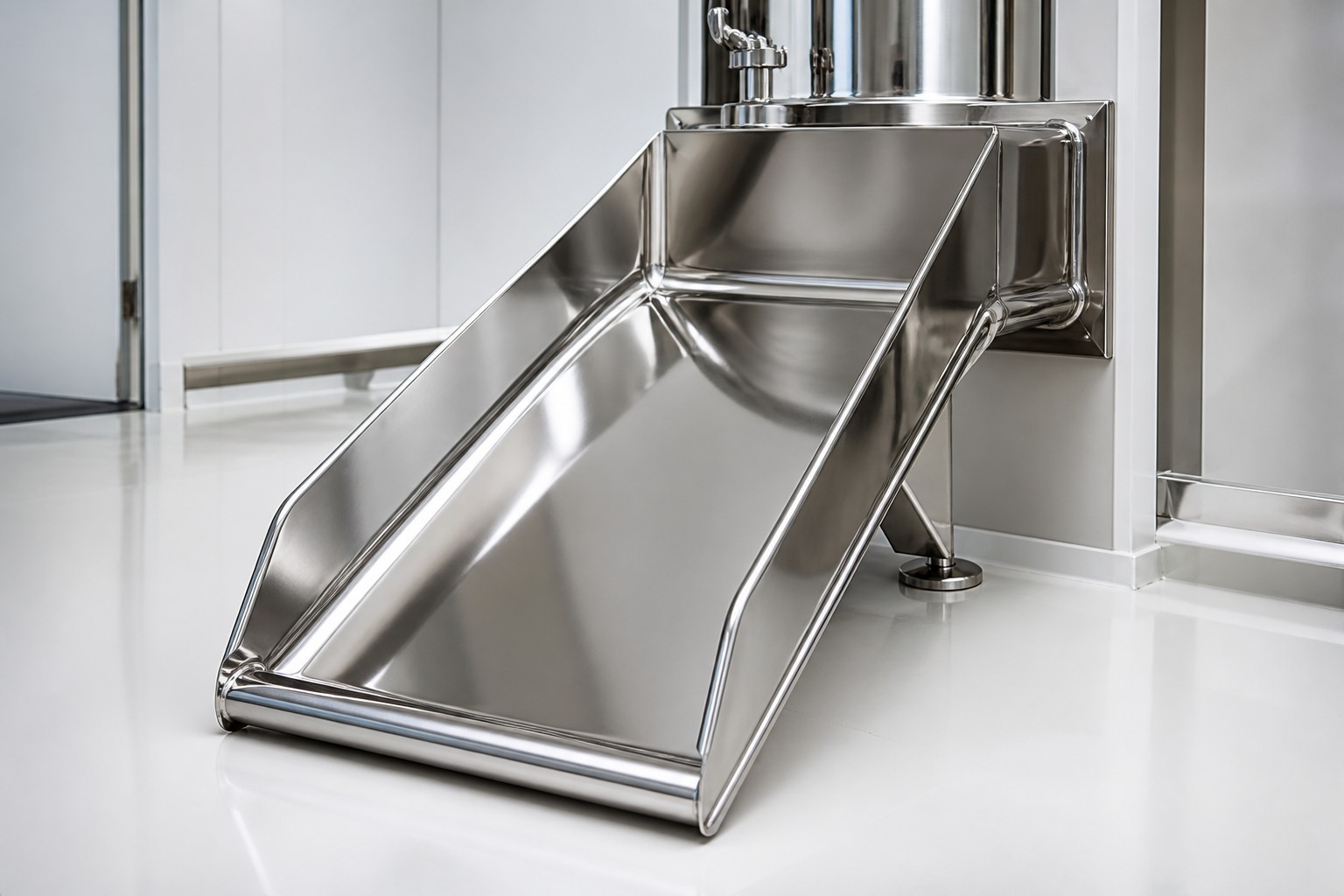
Food safety rules now drive every equipment purchase. Consequently, the demand for Food Grade Stainless Steel Fabrication keeps rising. Moreover, processors need audit-ready surfaces, not just shiny metal. Recently, a European dairy line integrator approached us. They needed sanitary transfer chutes for a new cheese plant.
1. Project Overview: Food Grade Stainless Steel Fabrication
Specifically, the client required a 316L sanitary stainless steel chute with a mirror finish. Therefore, we built a dedicated hygienic fabrication protocol around their CIP cleaning cycle.
| Specification Metric | Details & Standards |
|---|---|
| Product Manufactured | Food Grade 316L Sanitary Chutes (Dairy Transfer Line) |
| Industry & Application | Food & Beverage Processing, Dairy |
| Core Material | 316L Stainless Steel, 1.5 mm, Low-Sulfur Grade |
| Primary Processes | Laser Cutting, Hygienic Bending, Orbital TIG Welding, Electropolishing |
| Surface Standard | Mirror electropolished food contact surface, Ra ≤ 0.8 µm |
| Certifications Met | FDA Compliant Materials, 3-A Sanitary Design Principles, ISO 9001 |
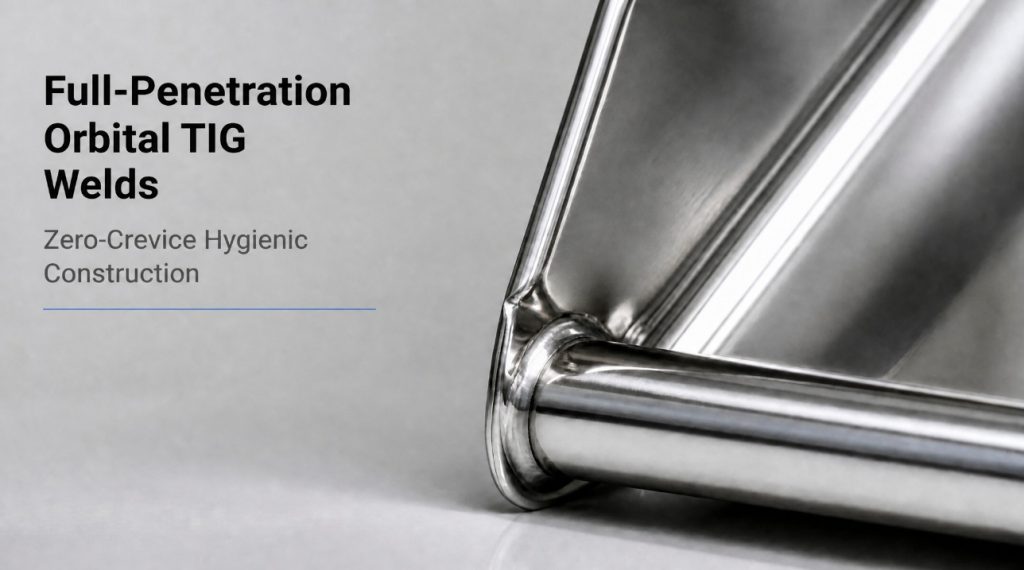
| Weld Standard | Full-penetration orbital TIG welds with zero crevices |
2. The Challenge: Hygiene Rules Everything
First, delivering dairy equipment stainless steel parts is a microbiology exercise, not a bending job. The program presented four critical challenges:
- Bacterial Harborage: Initially, every scratch or crevice can hide bacteria. However, auditors reject any food contact surface above Ra 0.8 µm. Therefore, the finish spec became the core of the contract.
- Weld Integrity: Additionally, manual welds often leave crevices and heat tint. As a result, we specified orbital TIG welding with full argon purge on every seam.
- CIP Compatibility: Also, the chute must survive daily caustic clean-in-place cycles. Consequently, we chose 316L over 304 for its chloride resistance.
- Audit Documentation: Finally, the integrator needed full material and finish records. In short, traceability became a deliverable, not a favor.
To solve these challenges, the client selected DeepLink Metal Fab. They trusted our stainless steel fabrication expertise and our in-house electropolishing and metal finishing services.
3. The DeepLink Solution: A Sanitary Fabrication Protocol
In response, DeepLink ran a closed hygienic protocol. Every station protected the surface from carbon steel, grit, and crevice risk.
Step 1: Material Control with Low-Sulfur 316L
Initially, we sourced low-sulfur 316L coil only. Next, every sheet carried a mill certificate with heat number. Consequently, full traceability started at the dock. Our metal fabrication materials program governs this control.
Step 2: Contamination-Free Forming
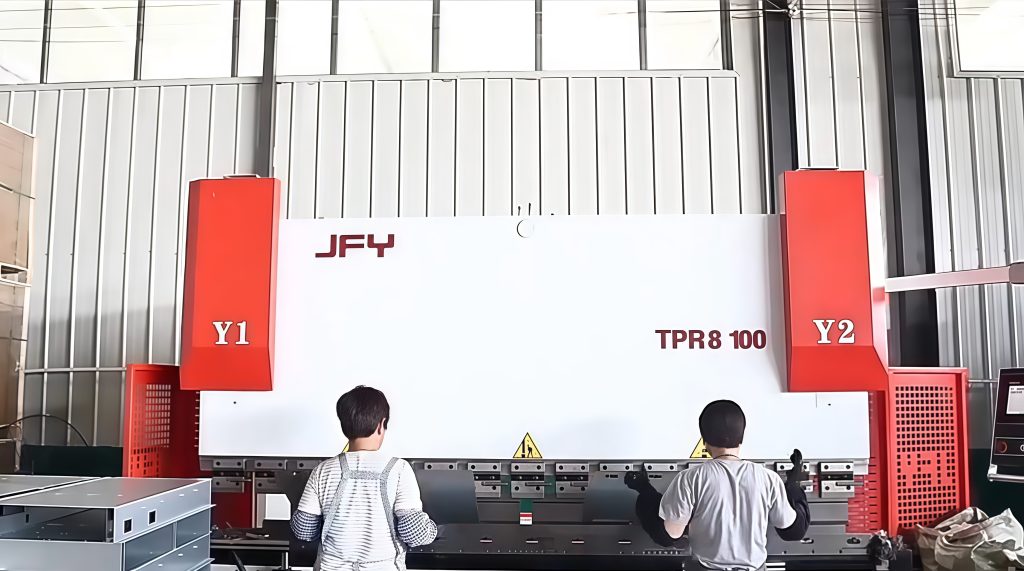
Subsequently, our team formed the chute on dedicated stainless-only tooling. This rule prevents embedded carbon steel particles. Such particles rust and pit food contact surfaces later. The same discipline supports our CNC press brake bending work.
Step 3: Orbital TIG Welding with Full Purge
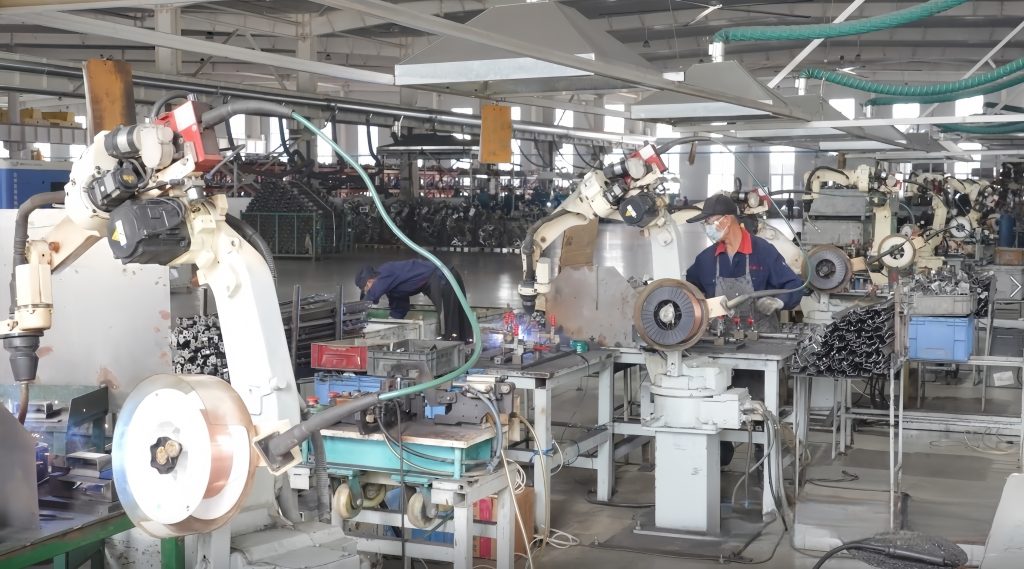
After that, welders joined seams with orbital TIG and full argon purge. The welds show even color and zero crevices. Moreover, borescope checks verified the internal bead. This standard matches our precision metal welding service spec.
Step 4: Grinding, Then Mirror Electropolishing
Following that, technicians ground every weld flush. Then the parts entered our electropolishing line. The process removed free iron and raised the chrome-oxide layer. As a result, each chute left as a mirror electropolished food contact surface at Ra 0.5 µm. You can review this process on our finishes page.
Step 5: CMM, Borescope, and the Documentation Pack
Finally, quality engineers measured flange geometry on CMM machines. They also borescoped every internal weld. Then we compiled the audit pack: mill certs, weld logs, and finish records. Machined flanges came from our precision CNC milling cell.
4. The Results: Audit-Ready Hygiene
By controlling material, welding, and finish in-house, DeepLink delivered outstanding results for this Food Grade Stainless Steel Fabrication program:
- 45% Faster CIP Cycles: First and foremost, the mirror surface shed residue quickly. Consequently, the plant cut cleaning time by 45% per cycle.
- Ra 0.5 µm Final Finish: Furthermore, profilometer readings averaged Ra 0.5 µm. As a result, every chute beat the Ra 0.8 µm spec.
- Zero Weld Crevices: After borescope inspection of 100% of seams, the client logged zero crevice findings.
- First-Pass Audit: Finally, the documentation pack passed the integrator’s sanitary audit on first submission.
5. Engineer’s Insight: The Surface Is the Product
“In a food plant, the surface is the product. A mirror finish is not decoration. It is a bacterial defense line. Therefore, we treat every Ra reading as a safety record, not a cosmetic number.”
— Senior Hygienic Design Engineer, DeepLink Metal Fab
Need Audit-Ready Sanitary Components?
Perhaps you need chutes, hoppers, or enclosures for food and beverage lines. In any case, DeepLink can fabricate them to FDA and 3-A expectations. You can also browse more proof in our case studies archive.
Get an Instant Online Quote today. Alternatively, review alloy options in the materials sourcing guide before you finalize your drawing.