Manufacturing a high-precision industrial UAV aluminum chassis demands a careful balance between extreme weight savings and rigid structural strength. This case study explains how DeepLink Metal Fab built a lightweight aluminum drone frame for a leading manufacturer of industrial and agricultural drones.
DeepLink successfully manufactured lightweight, high-strength aluminum chassis for a leading industrial UAV manufacturer. By using precision 5052 aluminum sheet metal bending and 5-axis CNC machining, DeepLink produced an industrial UAV aluminum chassis with a 40% weight reduction. Moreover, the chassis met stringent aerospace load-bearing requirements. The whole project ran inside an ISO 9001:2015 certified facility. In addition, it featured MIL-A-8625 Type III hard anodizing for extreme environmental resistance. DeepLink delivered rapid prototypes in 3 days and scaled to zero-MOQ mass production. As a result, the client reached the market 25% faster.
1. The Engineering Challenge of Industrial UAVs
To begin with, unmanned aerial vehicles (UAVs) for agricultural spraying, surveying, and industrial payloads face conflicting engineering demands. To maximize flight time and payload capacity, the frame must be exceptionally lightweight. However, to endure high-torque rotor vibrations and harsh outdoor elements, that same frame must also deliver incredible structural rigidity.
Therefore, a top-tier commercial drone manufacturer approached DeepLink Metal Fab. For example, their carbon-fiber prototypes were proving too brittle under heavy payload stress. Furthermore, they were prohibitively expensive for high-volume manufacturing. Consequently, the client needed a robust metal alternative.
Key Manufacturing Challenges:
- Strict Weight Constraints: The metal chassis could not exceed the weight of the previous composite iteration. At the same time, it needed 50% higher shear strength.
- Complex Geometry and Tolerances: Motor mounting arms and payload attachment points required a precise ±0.05mm tolerance. This ensured perfect rotor alignment and prevented mid-air vibration.
- Corrosion Resistance: The drones operate in corrosive environments, such as agricultural chemicals and coastal humidity. Therefore, they demanded an aerospace-grade surface finish.
2. DeepLink’s Industrial UAV Aluminum Chassis Solution
Our engineering team conducted a rapid Design for Manufacturability (DFM) review. Afterward, we proposed a shift to 5052-H32 Aluminum Alloy. Similarly, this specific grade of aluminum offers excellent workability for sheet metal forming, high fatigue strength, and strong receptivity to hard anodizing.
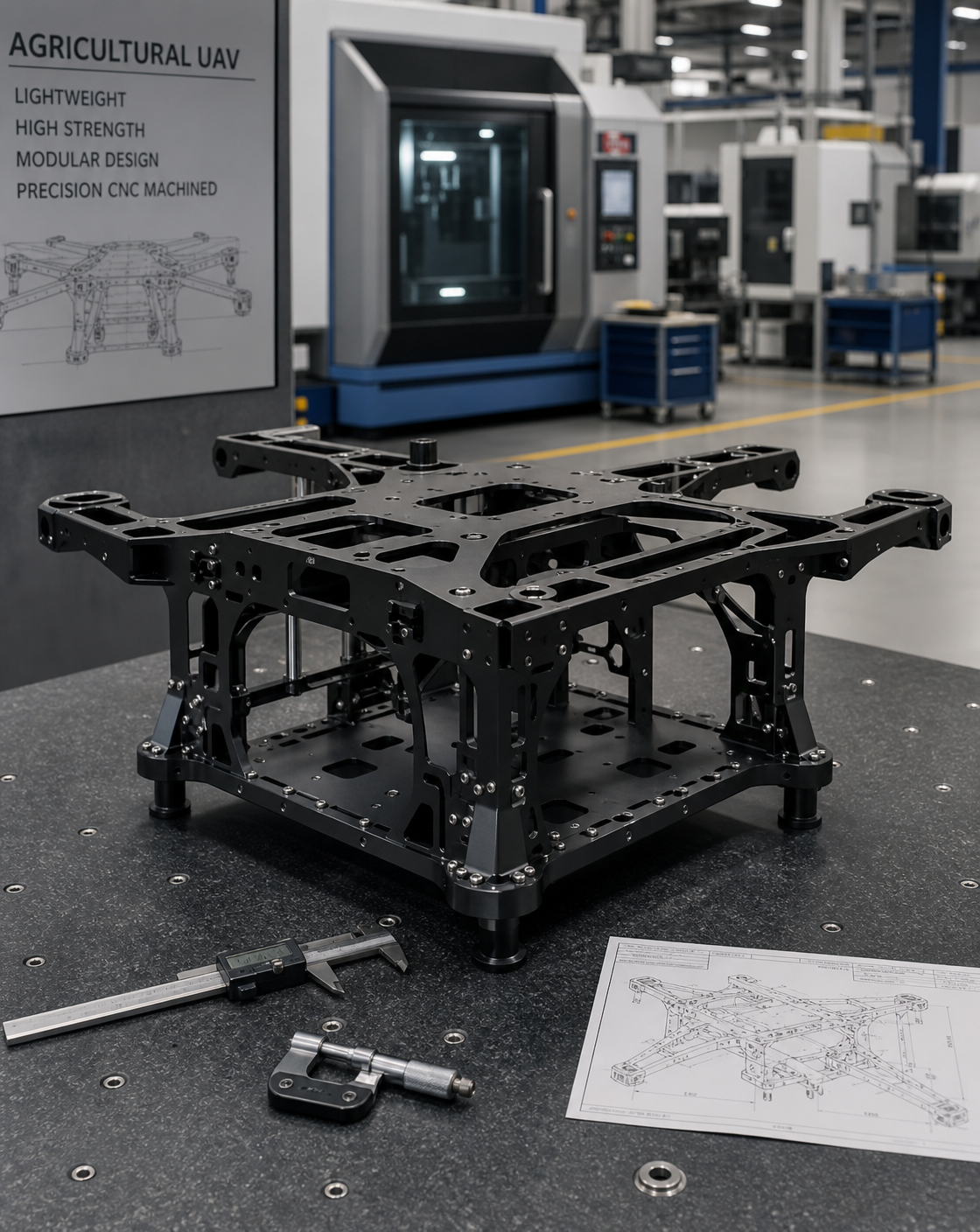
Caption: A lightweight 5052 aluminum chassis for an agricultural UAV, fabricated by DeepLink Metal Fab with a matte black hard-anodized finish.
Precision Laser Cutting and Complex Bending
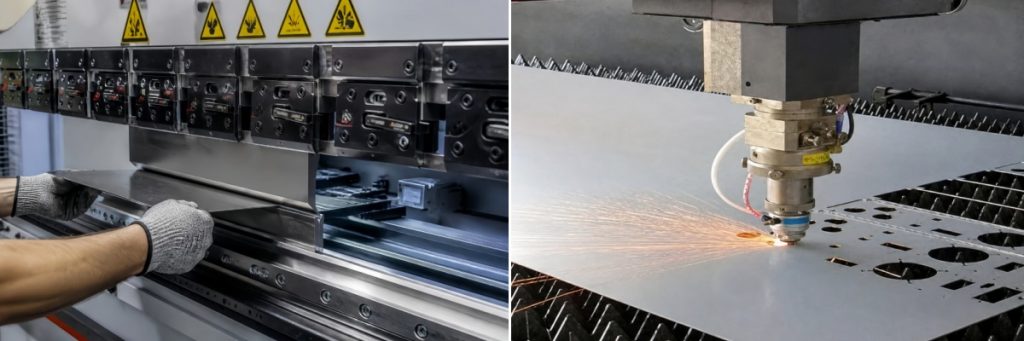
To achieve the intricate weight-reduction cutouts without weakening structural integrity, we used high-speed CNC fiber laser cutting. This sheet metal fabrication method created a complex honeycomb lattice across the main body plate. As a result, we removed 40% of the raw material weight.
After that, we used multi-axis CNC press brakes to form the aerodynamic angles of the chassis. By bending the aluminum instead of assembling separate flat plates, we eliminated heavy fasteners and weak weld seams in high-stress zones.
5-Axis CNC Machining for Critical Interfaces
Sheet metal bending forms the core structure, yet the rotor mounting brackets require absolute precision. Therefore, we transferred the formed chassis to our CNC machining centers. Meanwhile, using 5-axis milling, we machined the motor mounts and camera gimbal interfaces to a strict ±0.05mm tolerance. Moreover, this hybrid approach combined cost-effective sheet metal forming with ultra-precise CNC machining. Consequently, it delivered the perfect balance of scale and accuracy.
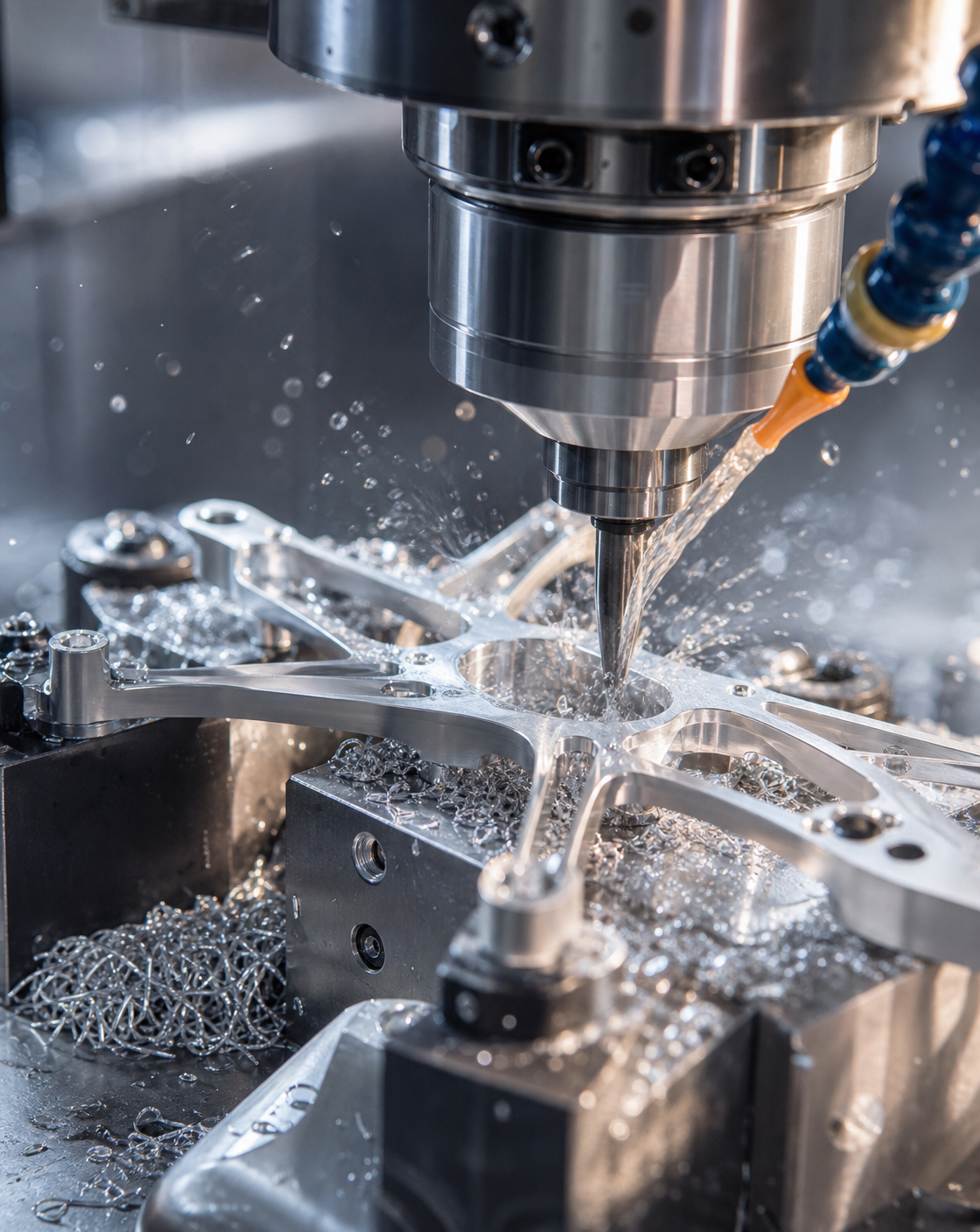
Caption: DeepLink’s 5-axis CNC machining center achieving micron-level precision on the rotor mounting interfaces of the aluminum UAV chassis.
Aerospace-Grade Surface Treatment for the Industrial UAV Aluminum Chassis
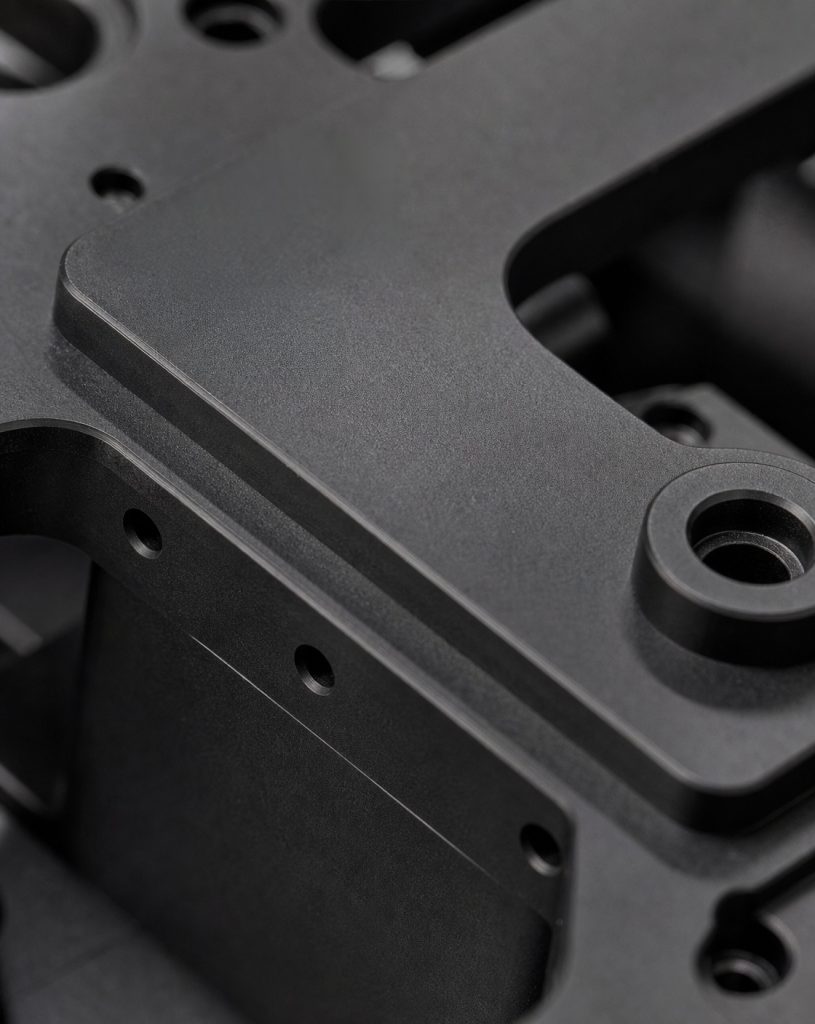
To combat corrosive agricultural fertilizers and outdoor elements, we subjected the final chassis assemblies to MIL-A-8625 Type III Hard Coat Anodizing. Specifically, this electrochemical process converts the metal surface into a highly durable, non-conductive anodic oxide finish. Furthermore, it drastically improves wear resistance while maintaining the drone’s stealthy matte-black appearance.
3. Technical Specifications & Quality Assurance
Manufacturing components for the aerospace and drone industries requires zero margin for error. DeepLink’s ISO 9001:2015 and ISO 14001 certified facility relies on 39+ rigorous QA checks. In addition, it uses Coordinate Measuring Machines (CMM) to verify every critical dimension of the industrial UAV aluminum chassis before shipment.
| Parameter | Specification Details |
|---|---|
| Material | 5052-H32 Aluminum Alloy |
| Fabrication Processes | Fiber Laser Cutting, CNC Bending, 5-Axis CNC Milling |
| Dimensional Tolerance | Main body ±0.1mm, Motor mounts ±0.05mm |
| Weight Reduction | 40% reduction via engineered CNC lattice cutouts |
| Surface Finish | MIL-A-8625 Type III Hard Black Anodizing |
| Lead Time | Rapid prototyping in 3 days, mass production in 14 days |
4. Results and Client Impact
By partnering with DeepLink Metal Fab, the client replaced their expensive carbon-fiber frames with a superior aluminum chassis. In addition, our integrated, zero-handoff production line ensured stable quality and eliminated supply chain friction.
Meanwhile, the new aluminum design passed all rigorous dynamic flight tests. It extended the drone’s payload capacity by 15% without sacrificing battery life. In addition, the zero minimum order constraint (No MOQ) allowed the client to scale from 10 prototypes to high-volume production. As a result, the client reached the market 25% faster than their competitors.
Frequently Asked Questions (FAQ)
Why is 5052 aluminum preferred for industrial drone frames?
How does a hybrid manufacturing process benefit UAV chassis production?
Can DeepLink Metal Fab handle rapid prototyping for aerospace components?
Elevate Your Drone Manufacturing Capabilities
Stop letting complex hardware delay your launch. Upload your 3D CAD files (STEP, STP, SLDPRT) to our secure portal to get instant DFM feedback and transparent pricing. Get Your Custom Metal Fabrication Quote in 24 Hours or contact our engineering team directly at business@deeplinkpro.com.