
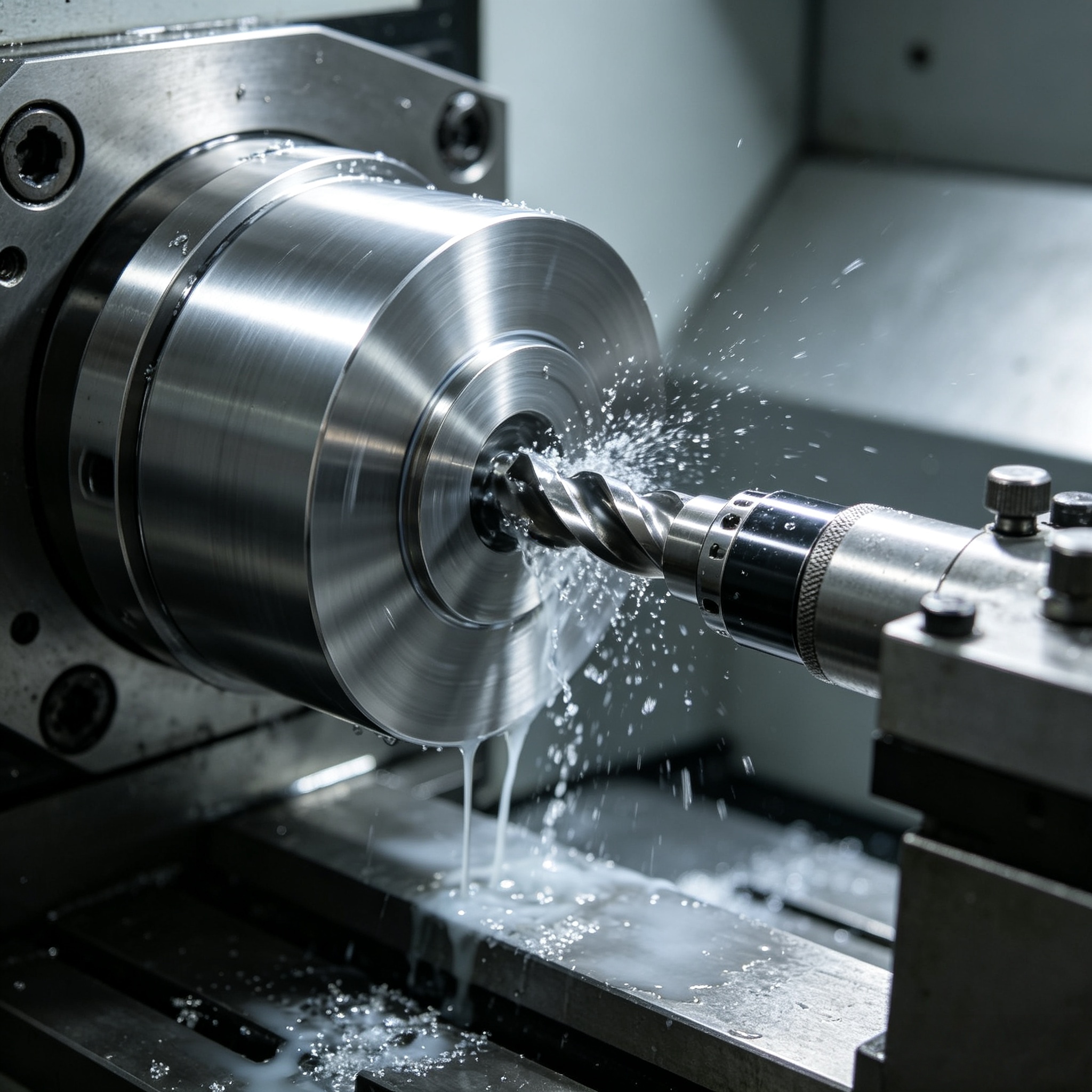
Working Principle of CNC Turning
Manufacturing for Rotational Components
CNC turning is a core process for precision rotational parts. It removes material from a rotating blank while a cutting tool moves along a controlled path.
Cangzhou Deeplink International Supply Chain Co., Ltd. combines CNC turning with digital manufacturing and other metal fabrication processes. With more than 10 years of industry experience, Deeplink supports projects from DFM analysis to finished-product delivery. This article explains the working principle, key components, and production workflow of CNC turning.
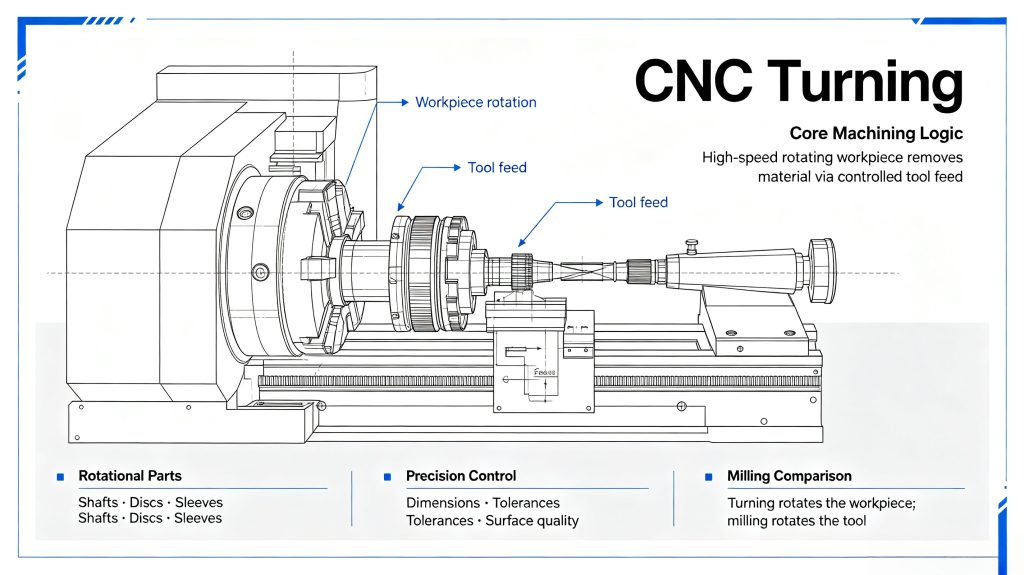
1. Core Definition of CNC Turning
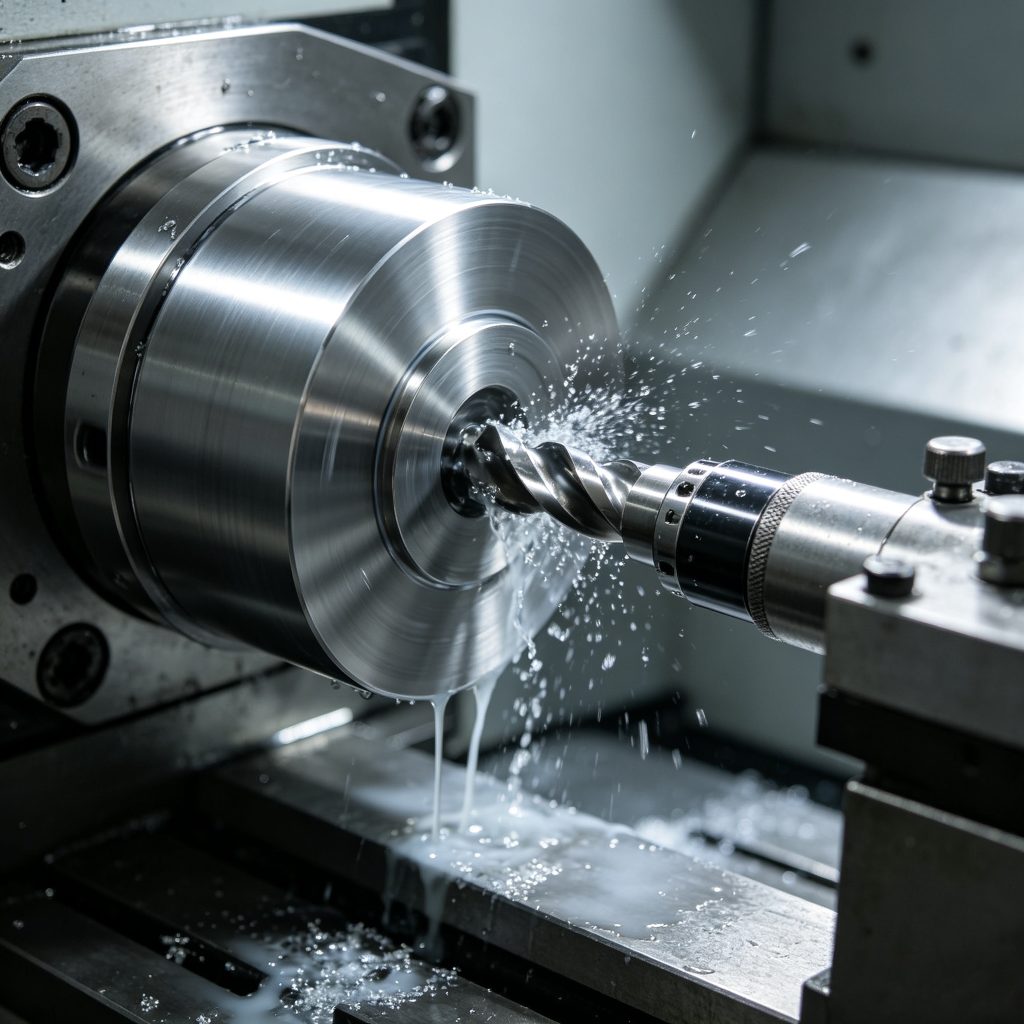
CNC turning stands for Computer Numerical Control turning. It is a precision cutting process for rotational parts. During machining, the workpiece rotates at high speed while the cutting tool follows a programmed feed path.
The tool removes material until the part reaches its required dimensions, geometric tolerances, and surface quality. Unlike milling, turning uses the rotating workpiece as the primary motion. The tool then moves in axial and radial directions.
This method suits shafts, discs, sleeves, and other symmetrical parts. It supports both one-piece prototypes and high-volume production.
2. Core Working Principle of CNC Turning
CNC turning follows a digital closed loop. The process connects the digital model, CNC program, machine movement, and material removal. Four coordinated stages create accurate rotational parts.
2.1 Digital Programming: From 3D Models to Machine Instructions
The process starts with a 3D model. Customers can submit STEP, STP, SLDPRT, DXF, or STL files. Engineers review the design and perform a Design for Manufacturability (DFM) analysis.
The DFM review identifies machining risks and improves the part structure. Next, engineers use Computer-Aided Manufacturing (CAM) software to create a G-code program. The program defines the tool path, spindle speed, feed rate, cutting depth, and other parameters.
At Deeplink, customers can receive an instant quote and DFM feedback after uploading a 3D model. As a result, they can evaluate manufacturability and cost before production begins.
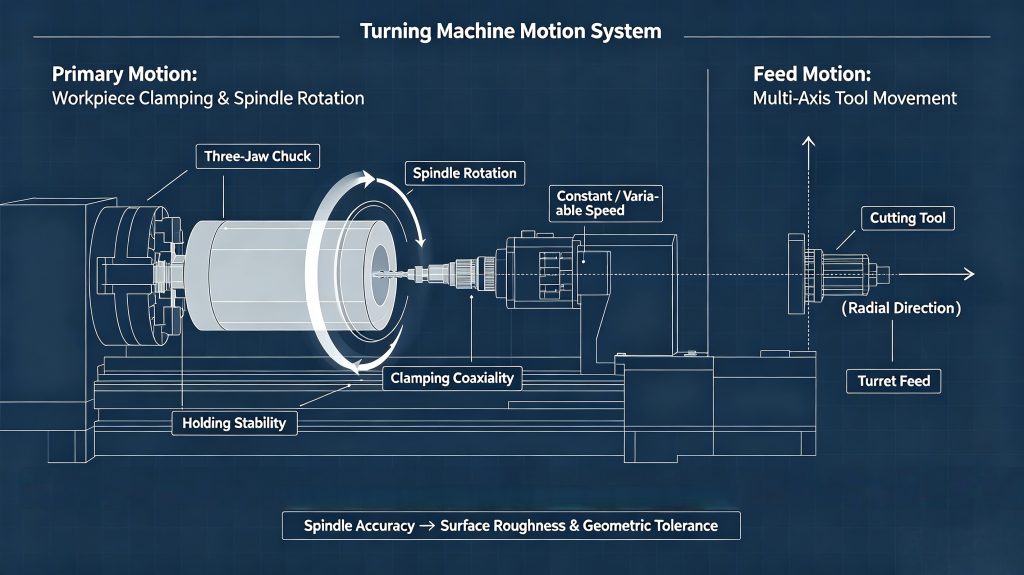
2.2 Primary Motion: Workpiece Clamping and Spindle Rotation
Before machining starts, the operator secures the blank in a three-jaw chuck, four-jaw chuck, or special fixture. Proper clamping keeps the workpiece stable and coaxial with the spindle.
Once the program starts, the spindle rotates the workpiece at a constant or variable speed. This rotation creates the primary cutting motion. It provides the energy needed to remove metal.
Spindle speed accuracy and rigidity affect surface roughness and geometric tolerance. Therefore, spindle performance directly influences the final part quality.
2.3 Feed Motion: Multi-Axis Tool Movement
While the workpiece rotates, the turret moves the cutting tool along two main axes. Each axis controls a different part feature.
- Z-axis (axial direction): The tool moves parallel to the workpiece axis. This motion controls axial length and supports face turning, external turning, and internal-hole machining.
- X-axis (radial direction): The tool moves perpendicular to the workpiece axis. This motion controls cutting depth and diameter. It also supports grooving and parting operations.
The X- and Z-axes can move together through interpolation. Consequently, the machine can create tapers, arcs, internal threads, and external threads. Servo motors drive the feed system, while position sensors provide closed-loop feedback. This control helps maintain micron-level dimensional accuracy.
2.4 Automatic Tool Changing and Process Integration
Modern CNC turning centers use multi-station turrets. A turret can hold external turning tools, boring tools, threading tools, grooving tools, and other cutters.
The CNC program rotates the turret and selects the required tool automatically. Therefore, one clamping can include turning, boring, threading, grooving, and chamfering. This setup reduces repositioning errors and improves production efficiency.
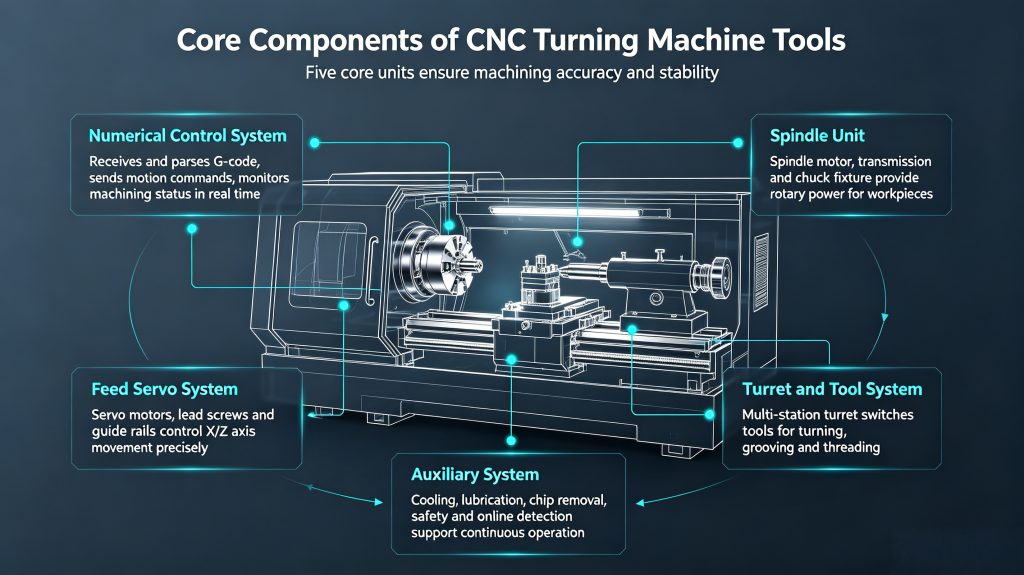
3. Core Components of a CNC Turning Machine
A CNC turning system uses five main units. Together, they control movement, cutting, safety, and inspection.
- Numerical control system: This is the machine’s control center. It reads G-code, sends movement commands, and monitors machining conditions.
- Spindle unit: The spindle motor, transmission system, and chuck rotate the workpiece. Spindle speed and rigidity affect the machine’s cutting capacity.
- Feed servo system: Servo motors, precision lead screws, and linear guide rails control X- and Z-axis movement. This system helps maintain machining tolerances.
- Turret and tool system: The automatic turret changes tools for different operations. Tool materials include cemented carbide and coated cutting tools for stainless steel, aluminum, carbon steel, and other metals.
- Auxiliary system: Cooling, lubrication, chip removal, safety protection, and online inspection systems support continuous and controlled production.
4. Complete CNC Turning Machining Process
Deeplink uses a standardized workflow from customer requirements to final delivery.
- Requirement review and DFM analysis: Customers provide drawings or 3D models. The technical team reviews manufacturability, suggests improvements, and prepares a quotation.
- Process planning and NC programming: Engineers select the clamping method, cutting parameters, tool path, and machine program.
- Workpiece clamping and machine setup: The team loads the blank, calibrates the tools, and runs the program without cutting to verify the tool path.
- First-article machining and inspection: The team machines the first article and checks its dimensions and geometric tolerances. Production begins after the sample passes inspection.
- Batch machining and in-process control: Automated lines continue production while operators perform regular sampling. The ISO quality system supports batch consistency.
- Post-processing and surface treatment: Deeplink performs deburring and polishing. It also offers anodizing, electroplating, sandblasting, and powder coating.
- Final inspection, packaging, and delivery: After final approval, the team packs the parts according to standard procedures and arranges shipment. After-sales support remains available with a 24-hour response.
5. Process Advantages and Technical Guarantees
Core Advantages of CNC Turning
- High accuracy: Closed-loop servo control supports tight dimensional tolerances. Surface roughness can reach below Ra 0.8 when the material and process allow.
- Strong batch consistency: Digital programs reduce manual operating errors. Consequently, part dimensions remain stable during mass production.
- High machining efficiency: One clamping can include several operations. Automated lines can also support continuous production.
- Wide material range: CNC turning can process carbon steel, stainless steel, aluminum alloys, copper alloys, and other metals.
- Flexible production: Engineers can switch part models by changing the machining program. This flexibility supports prototypes, small batches, and larger production runs.
Deeplink Process Support
Deeplink combines CNC turning with a wider metal manufacturing system.
- Automated capacity: Six automated production lines operate at an overall automation rate of 80 percent. This setup balances production speed and quality stability.
- Quality certifications: The company holds ISO 9001, ISO 14001, ISO 45001, SGS, RoHS, and REACH certifications. It also operates a structured quality management system.
- Flexible service: Deeplink supports projects without a minimum order quantity. It can provide rapid prototypes in 2 to 3 days when production conditions allow.
- Full-link support: Services cover technical consulting, drawing support, sample testing, machining, packaging, transportation, and after-sales service. Product liability insurance provides additional customer protection.
6. Typical Applications of CNC Turning
CNC turning combines precision, efficiency, and flexibility. Therefore, manufacturers use it across many high-end industries.
- Automotive manufacturing: Transmission shafts, pistons, bearing sleeves, valve bodies, and other precision parts.
- New energy: Battery structural parts, motor shafts, connectors, and related components.
- Aerospace and shipbuilding: High-precision rotational structures, fasteners, and other critical components.
- Medical devices: Medical equipment structures, precision instrument parts, and other close-tolerance components.
- General industry: Hardware fasteners, hydraulic parts, packaging-machine components, and other industrial accessories.
Conclusion
CNC turning is a key digital manufacturing process for precision rotational parts. It uses programmed instructions, controlled spindle rotation, accurate tool movement, and feedback systems to produce consistent results.
As manufacturers demand higher precision and faster delivery, CNC turning continues to evolve. Multi-axis machining, automation, and intelligent inspection will further improve its performance.
Deeplink combines CNC turning with DFM support, quality control, surface treatment, and logistics. Whether customers need prototypes or mass production, they can receive a coordinated solution from design to finished parts.